更新时间:08月26日
主演:未知
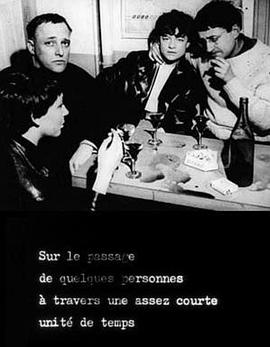
简介:Voice 1 (male professional announcer type) This neighborhood(1) was made for the wretched dignity of the petty bourgeoisie, for respectable occupations and intellectual tourism. The sedentary population of the upper floors was sheltered from the influences of the street. This neighborhood has remained the same. It was the strange setting of our story, where a systematic questioning of all the diversions and works of a society, a total critique of its idea of happiness, was expressed in acts. These people also scorned subjective profundity. They were interested in nothing but an adequate and concrete expression of themselves. Voice 2 (Debord, monotone) Human beings are not fully conscious of their real life - usually groping in the dark; overwhelmed by the consequences of their acts; at every moment groups and individuals find themselves confronted with results they have not wished. Voice 1 They said that oblivion was their ruling passion. They wanted to reinvent everything each day; to become the masters and possessors of their own lives. Just as one does not judge a man according to the conception he has of himself, one cannot judge such periods of transition according to their own consciousness; on the contrary, one must explain the consciousness through the contradictions of material life, through the conflict between social conditions and the forces of social production. The progress achieved in the domination of nature was not yet matched by a corresponding liberation of everyday life. Youth passed away among the various controls of resignation. Our camera has captured for you a few aspects of a provisional microsociety. The knowledge of empirical facts remains abstract and superficial as long as it is not concretized by its integration into the whole ” which alone permits the supersession of partial and abstract problems so as to arrive at their concrete essence, and implicitly at their meaning. This group was on the margins of the economy. It tended toward a role of pure consumption, and first of all the free consumption of its time. It thus found itself directly engaged in qualitative variations of everyday life but deprived of any means to intervene in them. The group ranged over a very small area. The same times brought them back to the same places. No one went to bed early. Discussion on the meaning of all this continued... Voice 2 Our life is a journey ” In the winter and the night. ” We seek our passage...� Voice 1 The abandoned literature nevertheless exerted a delaying action on new affective formulations. Voice 2 There was the fatigue and the cold of the morning in this much-traversed labyrinth, like an enigma that we had to resolve. It was a looking-glass reality through which we had to discover the potential richness of reality. On the bank of the river evening began once again; and caresses; and the importance of a world without importance. Just as the eyes have a blurred vision of many things and can see only one clearly, so the will can strive only incompletely toward diverse objects and can completely love only one at a time. Voice 3 (young girl) No one counted on the future. It would never be possible to be together later, or anywhere else. There would never be a greater freedom. Voice 1 The refusal of time and of growing old automatically limited encounters in this narrow, contingent zone, where what was lacking was felt as irreparable. The extreme precariousness of the means of getting by without working was at the root of this impatience which made excesses necessary and breaks definitive. Voice 2 One never really contests an organization of existence without contesting all of that organization's forms of language. Voice 1 When freedom is practiced in a closed circle, it fades into a dream, becomes a mere representation of itself. The ambiance of play is by nature unstable. At any moment ordinary life� can prevail once again. The geographical limitation of play is even more striking than its temporal limitation. Any game takes place within the contours of its spatial domain. Around the neighborhood, around its fleeting and threatened immobility, stretched a half-known city where people met only by chance, losing their way forever. The girls who found their way there, because they were legally under the control of their families until the age of eighteen, were often recaptured by the defenders of that detestable institution. They were generally confined under the guard of those creatures who among all the bad products of a bad society are the most ugly and repugnant nuns. What usually makes documentaries so easy to understand is the arbitrary limitation of their subject matter. They describe the atomization of social functions and the isolation of their products. One can, in contrast, envisage the entire complexity of a moment which is not resolved into a work, a moment whose movement indissolubly contains facts and values and whose meaning does not yet appear. The subject matter of the documentary would then be this confused totality. Voice 2 The era had arrived at a level of knowledge and technical means that made possible, and increasingly necessary, a direct construction of all aspects of a liberated affective and practical existence. The appearance of these superior means of action, still unused because of the delays in the project of liquidating the commodity economy, had already condemned aesthetic activity, whose ambitions and powers were both outdated. The decay of art and of all the values of former mores had formed our sociological background. The ruling class's monopoly over the instruments we needed to control in order to realize the collective art of our time had excluded us from a cultural production officially devoted to illustrating and repeating the past. An art film on this generation can only be a film on its absence of real creations. Everyone unthinkingly followed the paths learned once and for all, to their work and their home, to their predictable future. For them duty had already become a habit, and habit a duty. They did not see the deficiency of their city. They thought the deficiency of their life was natural. We wanted to break out of this conditioning, in quest of another use of the urban landscape, in quest of new passions. The atmosphere of a few places gave us intimations of the future powers of an architecture it would be necessary to create to be the support and framework for less mediocre games. We could expect nothing of anything we had not ourselves altered. The urban environment proclaimed the orders and tastes of the ruling society just as violently as the newspapers. It is man who makes the unity of the world, but man has extended himself everywhere. People can see nothing around them that is not their own image; everything speaks to them of themselves. Their very landscape is alive. There were obstacles everywhere. There was a cohesion in the obstacles of all types. They maintained the coherent reign of poverty. Everything being connected, it was necessary to change everything by a unitary struggle, or nothing. It was necessary to link up with the masses, but we were surrounded by sleep. Voice 3 The dictatorship of the proletariat is a desperate struggle, bloody and bloodless, violent and peaceful, military and economic, educational and administrative, against the forces and traditions of the old world. Voice 1 In this country it is once again the men of order who have rebelled. They have reinforced their power. They have been able to aggravate the grotesqueness of the ruling conditions according to their will. They have embellished their system with the funereal ceremonies of the past. Voice 2 Years, like a single instant prolonged to this point, come to an end. Voice 1 What was directly lived reappears frozen in the distance, fit into the tastes and illusions of an era, carried away with it. Voice 2 The appearance of events that we have not made, that others have made against us, now obliges us to be aware of the passage of time, its results, the transformation of our own desires into events. What differentiates the past from the present is precisely its out-of-reach objectivity; there is no more should-be; being is so consumed that it has ceased to exist. The details are already lost in the dust of time. Who was afraid of life, afraid of the night, afraid of being taken, afraid of being kept Voice 3 What should be abolished continues, and we continue to wear away with it. We are engulfed. We are separated. The years pass and we haven't changed anything. Voice 2 Once again morning in the same streets. Once again the fatigue of so many similarly passed nights. It is a walk that has lasted a long time. Voice 1 Really hard to drink more. Voice 2 Of course one might make a film of it. But even if such a film succeeds in being as fundamentally disconnected and unsatisfying as the reality it deals with, it will never be more than a re-creation ” poor and false like this botched traveling shot. Voice 3 There are now people who pride themselves on being authors of films, as others were authors of novels. They are even more backward than the novelists because they are unaware of the decomposition and exhaustion of individual expression in our time, ignorant of the end of the arts of passivity. They are praised for their sincerity since they dramatize, with more personal depth, the conventions of which their life consists. There is talk of the liberation of the cinema. But what does it matter to us if one more art is liberated through which Tom, Dick or Harry can joyously express their slavish sentiments The only interesting venture is the liberation of everyday life, not only in the perspectives of history but for us and right away. This entails the withering away of alienated forms of communication. The cinema, too, has to be destroyed. Voice 2 In the final analysis, stars are created by the need we have for them, and not by their talent or lack of talent or even by the film industry or advertising. Miserable need, dismal, anonymous life that would like to expand itself to the dimensions of cinema life. The imaginary life on the screen is the product of this real need. The star is the projection of this need. The images of the advertisements during the intermissions are more suited than any others for evoking an intermission of life. To really describe this era it would no doubt be necessary to show many other things. But what would be the point Better to grasp the totality of what has been done and what remains to be done than to add more ruins to the old world of the spectacle and of memories. 1. This film, which evokes the lettrist experiences at the origin of the situationist movement, opens with shots of the Paris district frequented by the lettrists in the early 1950s.